
Poultry Feed Blog Series: 1

Ask any procurement manager at a poultry feed mill what keeps them up at night, and moisture will be on the list. Not because it is difficult to measure, but because by the time most mills measure it, the truck is already at the gate, the purchase order is committed, and the decision has already been made.
Maize purchased at 17–18% moisture looks identical to maize at 13%. The difference is invisible to the eye and to any visual quality check. Yet that 4-5% moisture gap translates directly into Rs. 150-200 per tonne in added energy costs for on-site drying, reduced shelf life in storage silos, and elevated aflatoxin risk during the drying process itself.
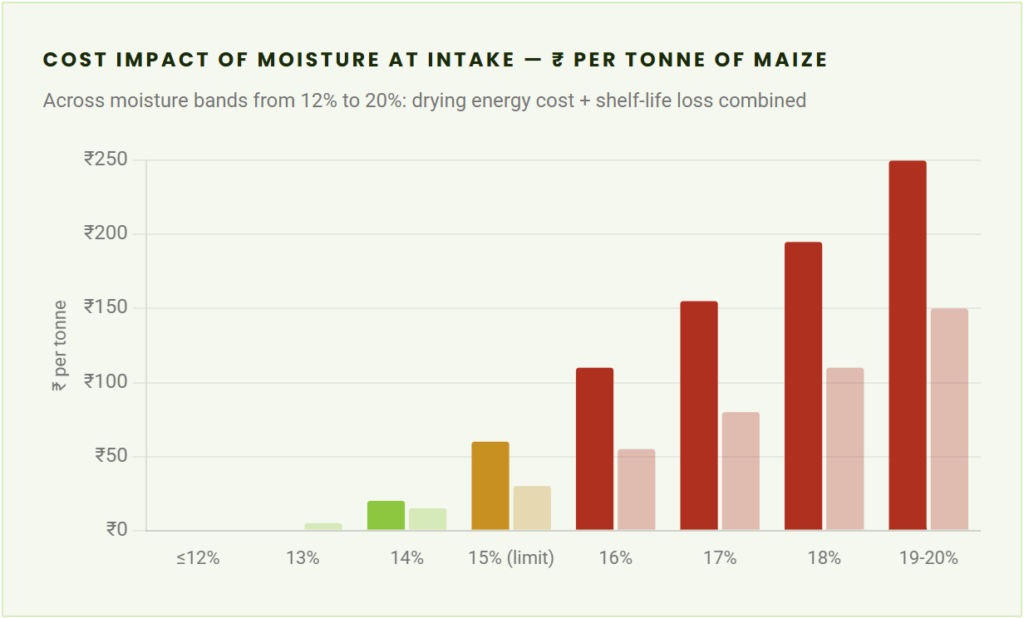
The maths is straightforward. At a feed mill processing 500 tonnes of maize per month, even a 50% rate of high-moisture lots (above 15%) adds Rs. 50,000 – Rs. 60,000 per month in drying costs alone i.e., Rs. 6 lakhs per year that never appears on a single invoice but quietly erodes every batch margin.
“The cost is not in the bill for the dryer. It is in the cumulative loss across 500 batches you never audited.”
The deeper issue is that this cost is entirely preventable if moisture is certified at the farm or FPO level, before the truck is loaded. A lot that fails moisture specification at source is not dispatched. No truck cost, no drying cost, no schedule disruption, no working capital tied up in a below-spec batch.
At RootsGoods, every maize lot entering our supply chain is scanned with NIR spectroscopy at the FPO gate. Moisture percentage is certified to within ±0.3% accuracy before the grain moves. Lots that exceed 15% moisture are flagged, held, and either returned or sun-dried at the FPO before dispatch thus, eliminating the problem at source rather than at your intake.
Part of RootsGoods Quality Certificate
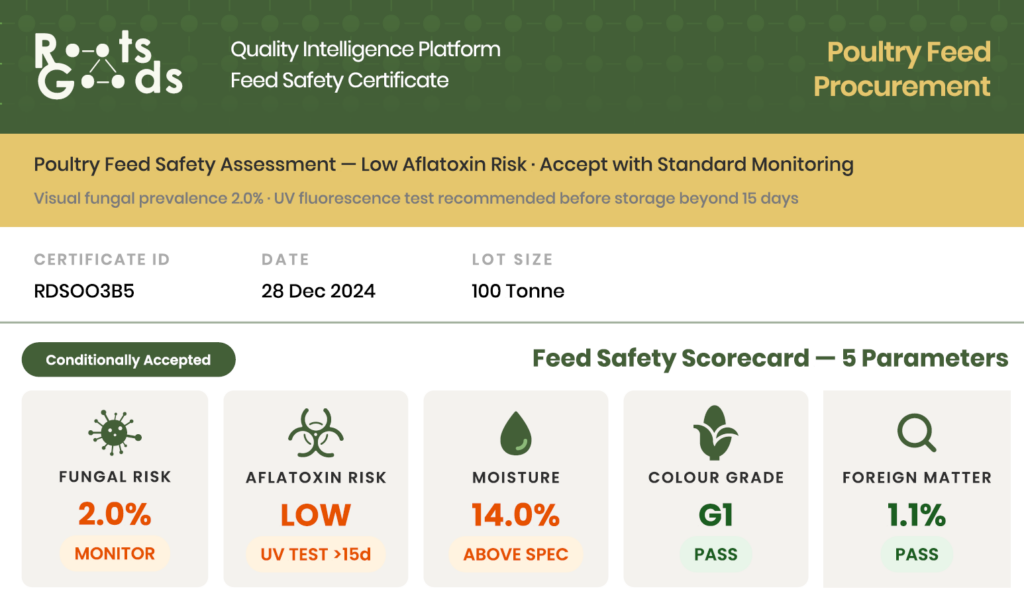
The result for our buyers: moisture-certified maize arrives within specification, on-site drying is eliminated for the majority of intake, and procurement teams can plan storage utilisation with confidence rather than guesswork.
In Part 2 of this series, we examine the second silent cost: protein shortfall and the excess soya supplement spend it forces every feed nutritionist to budget for.
